As alchemy moved through the Islamic world and into medieval Europe, it gained new practitioners, traditions, and layers of secrecy. Religious authorities sometimes viewed it with suspicion, while rulers alternately patronized alchemists in hopes of producing gold and turned against them when results failed to materialize. Yet the search itself encouraged careful observation, experimentation, and increasingly sophisticated laboratory techniques. The alchemists' symbolic language may make their manuscripts difficult to interpret today, but their experiments helped establish practical methods and investigative habits that would eventually become part of modern chemistry and medicine.
What Alchemists Actually Did: Laboratory Practice and Accidental Discovery
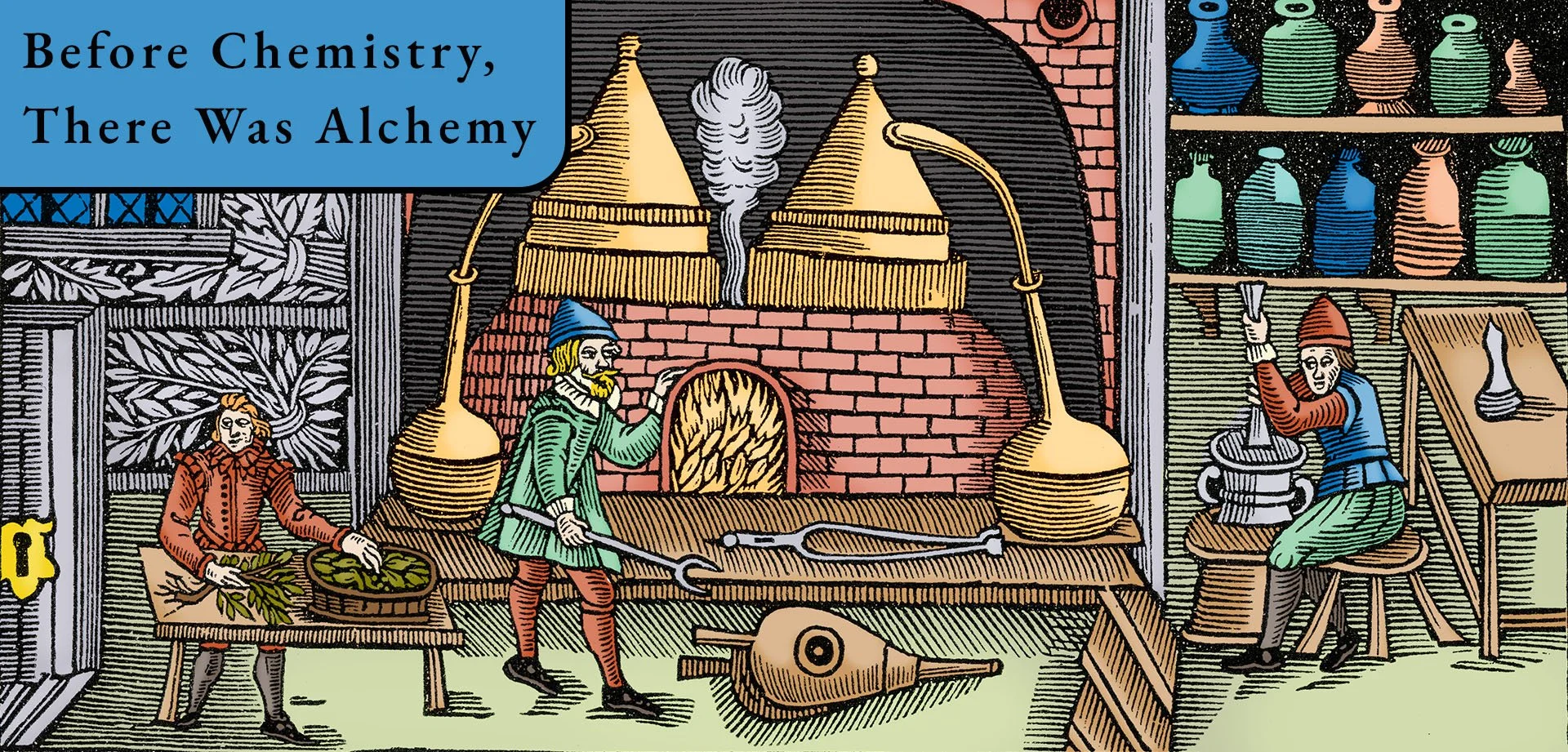
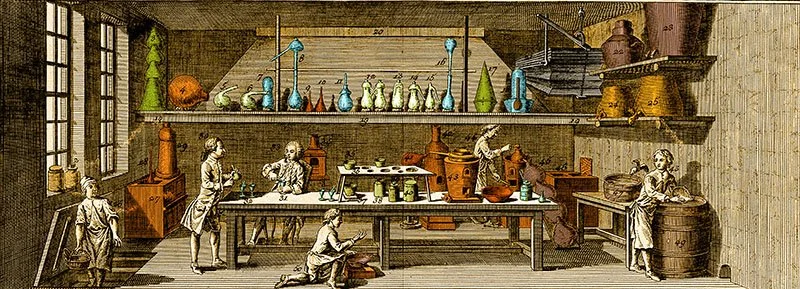
The alchemical laboratory was a serious and increasingly sophisticated working environment. Alchemists developed and refined techniques that remain fundamental to chemistry today: distillation, sublimation, calcination, filtration, and crystallization. They built furnaces capable of sustained high temperatures and worked systematically with acids, salts, sulfur, mercury, and a growing range of metallic compounds. The alembic, kerotakis, and water bath—still known in France as the bain-marie, and traditionally associated with the alchemist Maria Hebrea—were genuine laboratory innovations that outlasted the philosophical framework in which they were developed.
Discoveries from this work were often accidental, sometimes dangerous, and occasionally transformative. Albertus Magnus, the 13th-century philosopher and theologian, is generally credited with being the first to isolate elemental arsenic, around 1250, by heating an arsenic sulfide mineral. Berthold Schwarz, a German friar traditionally credited with refining gunpowder in the 14th century, illustrates how alchemical experimentation could have consequences far beyond its original aims.
Maria Zieglerin, a 16th-century German alchemist, is one of the rare documented women in this largely male historical record. Working under the patronage of Duke Julius of Brunswick, she claimed to possess the secret of the philosopher's stone and produced what she called Lion's Blood, an alchemical medicine. When she failed to deliver the promised results, she and others attempted to conceal the failure. This led to accusations of theft, poisoning, and murder, for which she was ultimately executed. Her case illustrates how an unsuccessful alchemical claim could become entangled with money, power, and serious criminal charges.
Perhaps the most memorable discovery of the alchemical era belongs to Hennig Brand, a Hamburg merchant-alchemist who in 1669 became the first person known to isolate a chemical element through deliberate experimentation. Brand collected and reduced large quantities of human urine, reportedly as much as 1,500 gallons, believing its golden color might offer a clue to making gold. It did not. Instead, prolonged heating produced a waxy white substance that glowed in the dark and burst into flame when exposed to air. Brand named it phosphorus, from the Greek for "light-bearer." He had isolated an element essential to DNA, bones, and cellular energy—and nearly asphyxiated himself with carbon dioxide in the process.
Key Figures in Alchemy History: From Mysticism to Scientific Method
The transition from alchemy to chemistry did not happen in a single moment of enlightenment. A handful of figures within the alchemical tradition drove it by insisting on observation, repeatability, and documentation over mystical interpretation. It was a gradual shift, and some of its most important figures had one foot firmly in each world.
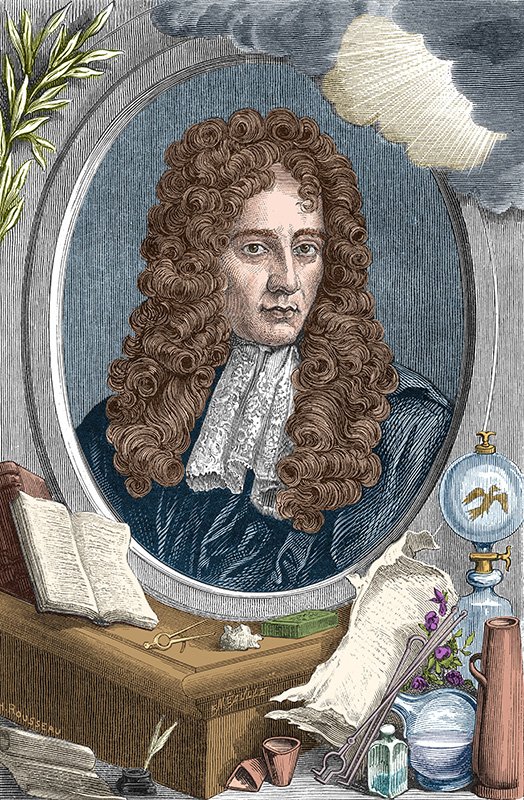
Robert Boyle, the 17th-century Anglo-Irish natural philosopher, is the figure most often credited with marking the turning point. His 1661 work The Sceptical Chymist directly challenged the Aristotelian framework of four elements, earth, air, fire, and water, that had underpinned alchemical theory for nearly two thousand years. He instead proposed defining elements experimentally as substances that could not be further decomposed by any known means. Boyle retained alchemical interests throughout his life, and his notebooks suggest he remained genuinely open to transmutation. But his insistence on experimental evidence over received doctrine made him the essential hinge figure between the two eras.
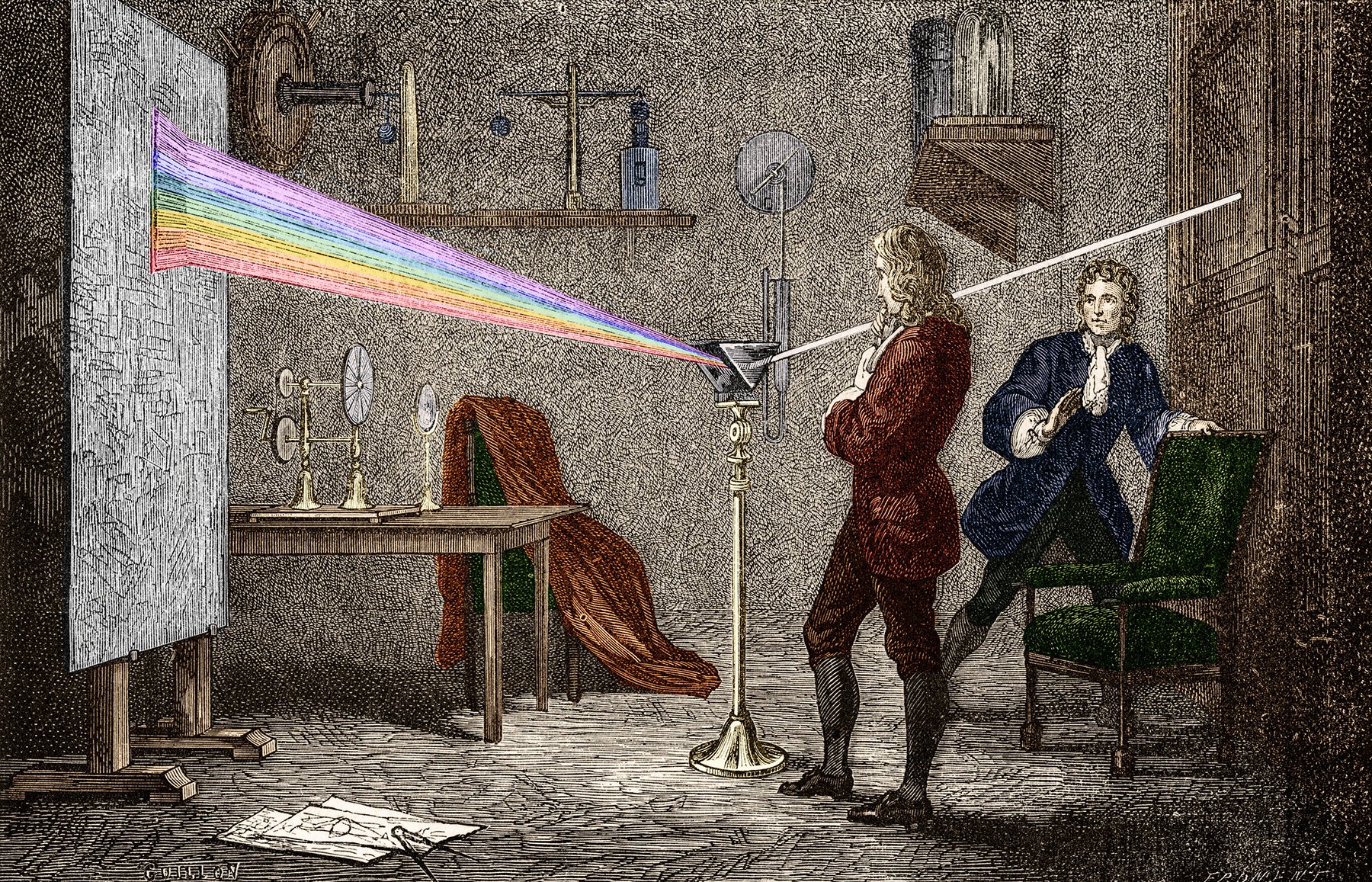
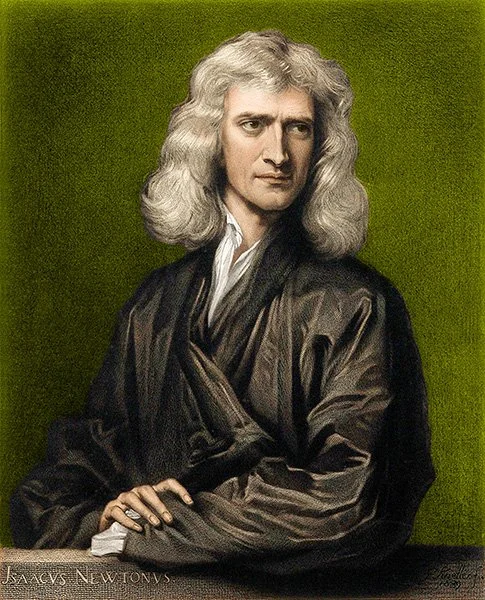
Isaac Newton occupies a stranger position in this story, and a more interesting one. Newton devoted a remarkable portion of his intellectual life to alchemical investigation. His surviving manuscripts on the subject run to nearly a million words, more than he wrote on physics and mathematics combined. He pursued the philosopher's stone with the same focused intensity he brought to optics and celestial mechanics, and he kept this work almost entirely private, well aware of both the professional and legal risks. Newton's alchemy did not produce the breakthroughs his physics did. But it is a useful reminder that the boundary between alchemy and natural philosophy in the 17th century was far more porous than the tidy history of science usually suggests.
Antoine Lavoisier helped complete the transformation in France in the late 18th century. By isolating oxygen, demonstrating the conservation of mass in chemical reactions, and systematizing chemical nomenclature, he helped establish modern chemistry. The French Revolution guillotined him in 1794 for his role as a tax collector. He reportedly asked for a brief delay to finish an important scientific experiment, but the request was denied—a pointed reminder that scientific work could not always protect those caught up in the political upheaval of the time.
From Alchemical Symbols to the Scientific Method: The Legacy of Alchemy in Modern Chemistry and Medicine
The philosopher's stone was never found. No alchemist successfully transmuted lead into gold, and the elixir of life remains a beautiful idea. Yet alchemy's legacy in modern science is real and surprisingly concrete.
The laboratory itself, as a dedicated space for controlled experimentation with specialized apparatus, is an alchemical inheritance. Distillation, which gave Brand his phosphorus, remains central to pharmaceutical purification. The systematic study of acids, alkalis, salts, and metals that became inorganic chemistry also has direct roots in alchemical practice. Alchemists isolated or described elements including phosphorus, bismuth, zinc, and antimony centuries before chemistry became a formal discipline.
Alchemy's contribution to medicine is equally significant. Paracelsus, the 16th-century Swiss physician-alchemist, challenged Galenic medicine by arguing that diseases had specific chemical causes and could be treated with specific chemical remedies. His use of mineral compounds helped lay the groundwork for pharmaceutical chemistry and, eventually, the principle of isolating substances and administering them in controlled doses.
What alchemy ultimately contributed to science was not gold, but method—developed imperfectly across centuries of secrecy, experimentation, and occasional catastrophe. The habit of observing matter carefully, recording results, and trying to reproduce them did not spring fully formed from the Enlightenment. It was practiced by people who believed the universe was knowable and that understanding it was worth pursuing. They were right about that, even when they were wrong about much else.
Alchemy and History of Science Stock Images for Publishers and Educators