• BLOG
    • Sell Your Work
    • Portfolio Submission Guidelines
    • Portfolio Submission Form
    • copyright
    • Medical Shot List
    • Physical Sciences Shot List
    • Social Sciences Shot List
    • Natural Sciences Shot List
    • Medical Portfolio Examples
    • Nature Portfolio Examples
    • Science Portfolio Examples
    • Medical Images
    • Natural History Images
    • Science Photos
    • Vintage Photos & Prints
    • Black History
    • Famous People Photos
    • History of Astronomy
    • History of Computers
    • History of Math
    • Nature Video
    • Science Videos
    • Request an On-Demand Project
    • Artists Overview
    • Emily Ciosek Portfolio
    • Ilusmedical Portfolio
    • Monica Schroeder Portfolio
    • Spencer Sutton Portfolio
    • Evan Oto Portfolio
    • Gwen Shockey Portfolio
    • 3D Illustration
    • Microbiology Illustration
    • Diseases and Conditions
    • Medical Illustration
    • Animals and Creatures Illustrations
    • Nature Illustration
    • 3D Medical Animation
    • Subscribe
    • Contact US
    • Educational Resources
    • Science Photos
    • Rights Managed
    • Royalty Free
    • Pricing
    • Payment Options
    • Clients & Art Buyers
Menu

Science Source | Stock Medical & Science Visual Content

Science and Medical Visual Content Stock Agency
  • BLOG
  • Creators
    • Sell Your Work
    • Portfolio Submission Guidelines
    • Portfolio Submission Form
    • copyright
    • Medical Shot List
    • Physical Sciences Shot List
    • Social Sciences Shot List
    • Natural Sciences Shot List
    • Medical Portfolio Examples
    • Nature Portfolio Examples
    • Science Portfolio Examples
  • Stock Photos
    • Medical Images
    • Natural History Images
    • Science Photos
    • Vintage Photos & Prints
    • Black History
    • Famous People Photos
    • History of Astronomy
    • History of Computers
    • History of Math
    • Nature Video
    • Science Videos
  • Illustration Services
    • Request an On-Demand Project
    • Artists Overview
    • Emily Ciosek Portfolio
    • Ilusmedical Portfolio
    • Monica Schroeder Portfolio
    • Spencer Sutton Portfolio
    • Evan Oto Portfolio
    • Gwen Shockey Portfolio
    • 3D Illustration
    • Microbiology Illustration
    • Diseases and Conditions
    • Medical Illustration
    • Animals and Creatures Illustrations
    • Nature Illustration
    • 3D Medical Animation
  • About
    • Subscribe
    • Contact US
    • Educational Resources
    • Science Photos
    • Rights Managed
    • Royalty Free
    • Pricing
    • Payment Options
    • Clients & Art Buyers

Sir Isaac Newton’s Prism Experiment

Isaac Newton and the Physics of Color: How a Prism Changed Everything

September 9, 2026

Before Isaac Newton understood color, he tried to feel it. In one of the more startling footnotes in the history of science, the young Newton pressed a bodkin — a blunt needle — between his eye and the bone of his eye socket, probing whether pressure on the eye would produce the same color effects as light. It did produce colors, as it happens, along with considerable risk to his vision. Newton recorded the experiment in his notebook and moved on, apparently undeterred.

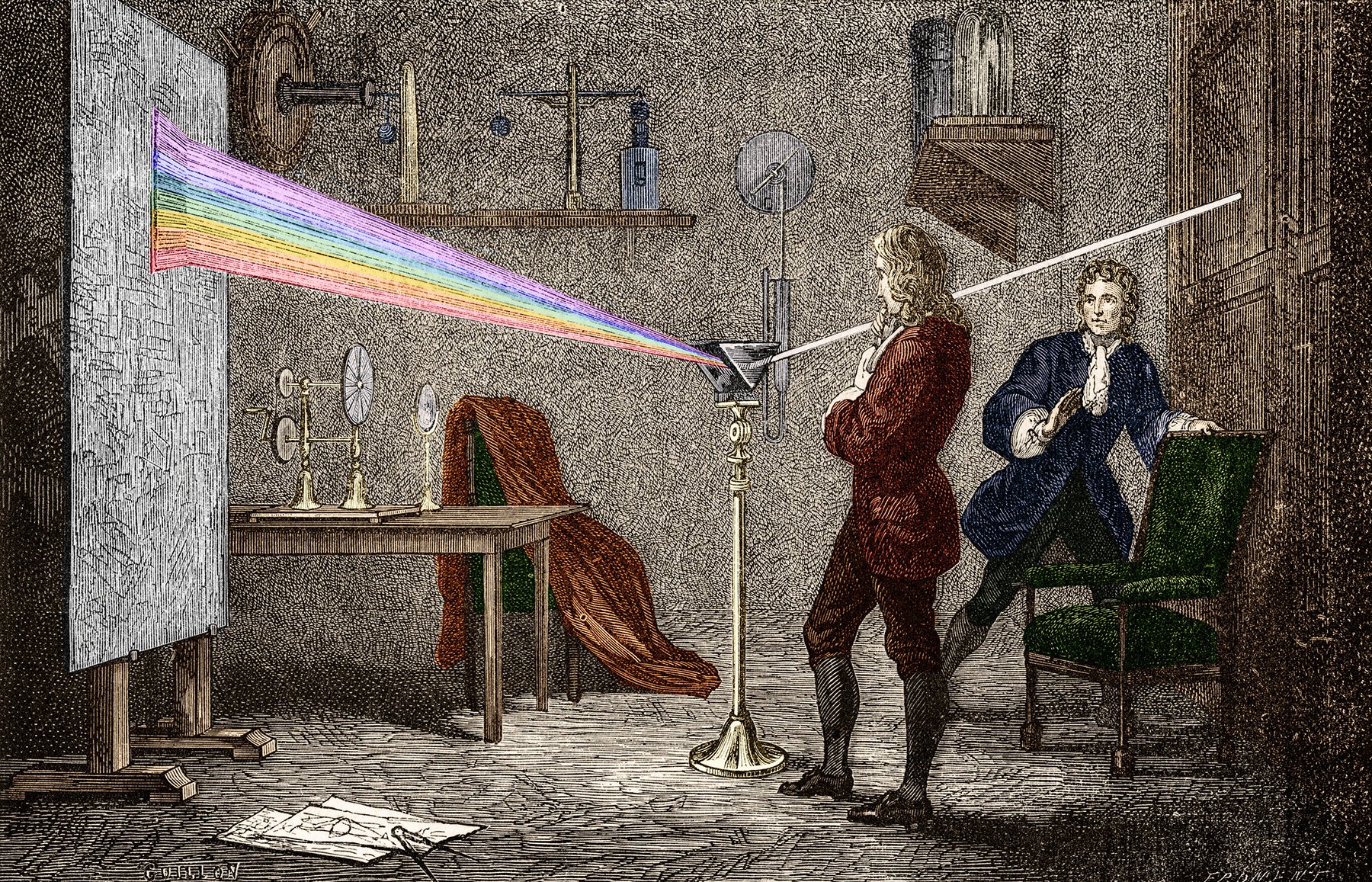
He eventually found a safer method. In a darkened room in 1666, he directed a narrow beam of sunlight through a glass prism and watched it fan out across the wall in a band of color — red, orange, yellow, green, blue, indigo, violet. Then he passed that spectrum through a second prism. The colors did not divide further. They recombined into white light.

Gallery of Isaac Newton and Optics Images for Licensing

With that, Newton established one of the foundational principles of optics: white light is not pure. It is a mixture, and a prism does not add color to light — it reveals the colors already present within it. It was a conclusion so counterintuitive it met immediate resistance. Nevertheless, it remains a cornerstone of physics more than 350 years later.

For publishers, educators, and science communicators building content around the physics of color and light, Newton's prism experiment is one of the most-illustrated moments in the history of science — and one of the most frequently mis-illustrated. At Science Source, our collection spans historical engravings, scientific portraits, and contemporary optics photography, offering imagery that is accurate to both the history and the physics.
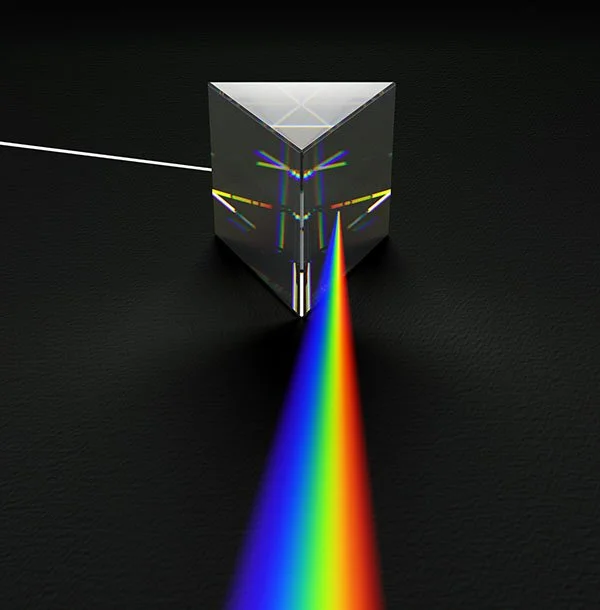
Prism demonstrating refraction and reflection effect. © David Parker / Science Source

Newton's Prism Experiment: What Actually Happened

The experiment Newton conducted in 1666 — which he later refined and published in his landmark 1704 work Opticks — was deceptively simple in setup and radical in conclusion. The key elements were:

  • A darkened room with a small hole in the shutter, admitting a single narrow beam of sunlight

  • A glass prism positioned to intercept the beam and refract it onto the opposite wall

  • A second prism used to recombine the dispersed spectrum back into white light

  • Careful observation that each color refracted at a slightly different angle — what we now call dispersion

The insight Newton drew from this was that different colors of light have different degrees of refrangibility — they bend by different amounts when passing through a medium. Red light bends least; violet bends most. This is why a prism separates white light into a spectrum, and why a rainbow forms when sunlight passes through raindrops. The prism does not create the colors. It unmixes them.

Newton identified seven colors in the spectrum — red, orange, yellow, green, blue, indigo, violet — a number he arrived at partly by observation and partly, historians suspect, by analogy with the seven notes of the musical scale. The decision to include indigo as a distinct color between blue and violet has been debated ever since. Most modern treatments of the visible spectrum treat it as a continuum rather than seven discrete bands, but Newton's seven-color framework remains the one most people learn first.

Isaac Newton and Optics: The Science Behind the Rainbow
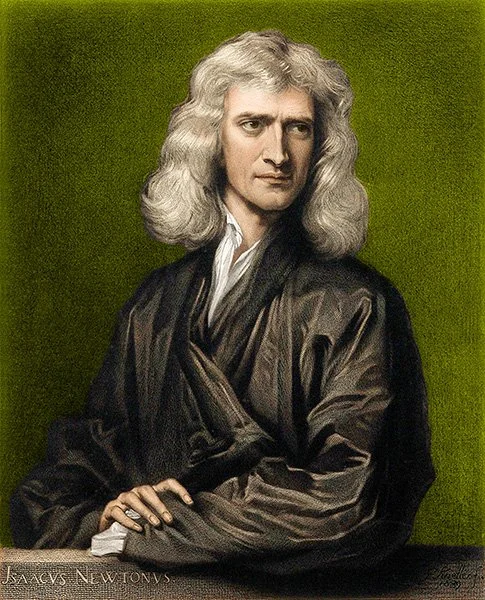
A portrait of Sir Isaac Newton, physicist. © Science Source

Newton's color work did not exist in isolation. It was part of a broader investigation into the behavior of light that occupied him for decades and produced some of the most consequential ideas in the history of physics. Understanding what Newton established — and why it was controversial — matters for publishers building accurate educational content around optics and the physics of color.

The central debate of Newton's era was whether light was a wave or a particle. Newton argued for a corpuscular theory — that light was made up of particles — which put him in direct conflict with the wave theories of his contemporaries, including Christiaan Huygens. The wave theory would eventually prevail, and then be complicated further by quantum mechanics in the 20th century, which revealed that light behaves as both. But Newton's corpuscular theory was not simply wrong; it was a productive framework that made accurate predictions about reflection, refraction, and color.

His work on optics also led directly to a practical invention: the reflecting telescope. Frustrated that refracting telescopes produced chromatic aberration — color fringing caused by lenses dispersing light just as prisms do — Newton designed a telescope that used a curved mirror rather than a lens to focus light. The Newtonian reflector remains a standard design in amateur and professional astronomy to this day.

Illustrating the Physics of Light and Color: Stock Images for Publishers and Educators

Newton's prism experiment is among the most-requested subjects in science publishing, appearing in physics textbooks, history of science publications, museum exhibition materials, and digital learning platforms. Publishers working in this space need imagery for various purposes:

  • Historical context — engravings, portraits, and period illustrations that place Newton in the intellectual landscape of the 17th century

  • Experimental documentation — accurate depictions of the prism experiment itself, showing apparatus, beam path, and spectral output

  • Contemporary optics — modern photography of light dispersion, refraction, diffraction, and color phenomena that connect Newton's discoveries to current science

  • Conceptual and diagrammatic imagery — illustrations of the visible spectrum, wavelength relationships, and the electromagnetic spectrum for educational publishing

At Science Source, our Newton and optics collection spans all four of these categories. Our historical material includes original engravings and portraits from the 17th through 19th centuries — the period when Newton's ideas were being disseminated, debated, and canonized across Europe. Our contemporary optics photography documents the same principles Newton investigated: dispersion, refraction, reflection, diffraction, and the relationship between light and color.

Why Scientific Accuracy in Historical Science Imagery Matters

Historical science imagery carries a particular accuracy burden that generic illustration cannot meet. A depiction of Newton's prism experiment must be correct not just aesthetically but experimentally—the geometry of the prism, the angle of the beam, the order of colors in the spectrum, and the presence of a second prism if the recombination experiment is shown. Errors in these details are not merely aesthetic; in educational publishing, they misrepresent the physics.

License Newton and Optics Images for Physics and History of Science Publishing
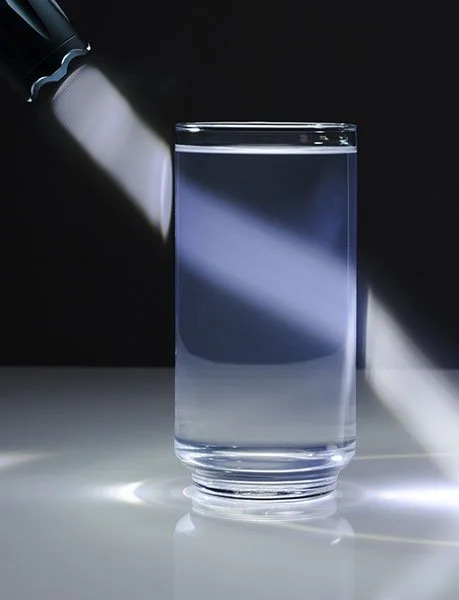
Light refraction through a glass of water. © Turtle Rock Scientific / Science Source

The hand-colored engraving that opens this post has served science publishers for nearly two centuries — it is one of the most reproduced images in the history of optics illustration, and for good reason. It captures Newton's experiment with the clarity of a diagram and the richness of a period document, placing the viewer in the darkened room where one of physics' great insights unfolded.

At Science Source, we hold an extensive collection of Newton and optics imagery — historical portraits and engravings, experiment documentation, contemporary light physics photography, and diagrammatic illustrations of the visible spectrum and electromagnetic radiation. Whether you are building a physics textbook, a museum exhibition, a digital learning platform, or a general science publication, our collection is searchable, licensable, and documented for educational and commercial use.

The physics of color has not changed since 1666. The quality of imagery available to illustrate it has.

Browse Science Source's Newton and optics collection at sciencesource.com

Why Younger Adults Are Getting Shingles →

Science Source® provides authentic, high-quality photography, illustration, and video focused on healthcare, biomedicine, technology, the physical sciences, and the natural and life sciences.

BLOG RSS

Discover Science Art, Apparel & Unique Gifts

  • 2026
    • Sep 9, 2026 Isaac Newton and the Physics of Color: How a Prism Changed Everything
    • Aug 27, 2026 Why Younger Adults Are Getting Shingles
    • Aug 17, 2026 Understanding Gout: A Growing Form of Inflammatory Arthritis
    • Aug 13, 2026 Type 2 Diabetes: The Cellular Story Behind a Growing Epidemic
    • Aug 3, 2026 The History of Astronomy Part 2: Kepler, Galileo, Newton, and the Birth of Modern Astronomy
    • Jul 28, 2026 The History of Astronomy Part 1: From the Astrolabe to Copernicus
    • Jul 20, 2026 The 1927 Solvay Conference Photo: The History Behind Science's Most Famous Image (Now in Color)
    • Jul 16, 2026 Hidradenitis Suppurativa: An Underdiagnosed Skin Condition That Needs Better Imagry
    • Jul 8, 2026 COVID-19 and Cardiovascular Risk
    • Jun 30, 2026 Chemistry Experiment Images That Teach Science Well
    • Jun 23, 2026 Eczema: The Itch That Rewrites Daily Life and the Images That Tell Its Story
    • Jun 19, 2026 A Comprehensive Resource for Psoriasis Visuals
    • Jun 16, 2026 Visualizing Fragile X Syndrome
    • Jun 10, 2026 Grace Hopper and the First Computer Bug: A Legendary Legacy
    • Apr 7, 2026 CAR T-Cell Therapy: Engineering the Immune System to Fight Cancer
    • Mar 20, 2026 How Marie Curie Saved Lives, Women's History Month
    • Feb 26, 2026 The Vagus Nerve: Hype, Science, and Clinical Reality
  • 2025
    • Dec 30, 2025 The Cycles of Life, Science, and Nature
    • Oct 22, 2025 The Science of the Measles
    • Sep 26, 2025 New Paleoartists Bring the Prehistoric World to Life: Simone Zoccante, Mohamad Haghani and Gustavo Higón
    • Sep 18, 2025 Authentic Sickle Cell Disease Visual Content for Healthcare, Education, and Publishing
  • 2023
    • Feb 7, 2023 Psychology in Pictures
  • 2022
    • Jun 11, 2022 Myasthenia Gravis, an Autoimmune Disease
    • May 20, 2022 Monkeypox Now in the United States, the UK and Europe
    • Mar 16, 2022 The Curious Case of Phineas Gage
    • Mar 10, 2022 Mitosis Cell Division: Amazing Stock Science Footage
    • Feb 10, 2022 The Most Famous Solvay Conference on Physics
    • Feb 3, 2022 American Heart Month: How the Heart Works
    • Jan 19, 2022 MLK day and African American History Footage
  • 2021
    • Nov 9, 2021 Microscope Photos (SEMS) Make Unique Gifts for the Science Minded
    • Nov 7, 2021 Cajal, the Father of Modern Neuroscience - Great Gift Idea For Nerds & Scientists
    • Nov 1, 2021 Diversity in Health, Work, and Educational Stock Photos
    • Sep 21, 2021 Spark Imagination With Conceptual Images
    • Aug 24, 2021 You Are Never Alone When Follicle and Eyelash Mites Live on Your Face
    • Jul 14, 2021 Space Travel: Then and Now
    • Jun 29, 2021 Mosquitos and Dengue Fever
    • Jun 14, 2021 How to Live Forever: Rotifers, Nematodes and Tardigrades
    • Feb 19, 2021 Gifts for Lovers of Classical Music
    • Jan 29, 2021 The Real Pocahontas
    • Jan 20, 2021 Blackbeard and Other Swashbuckling Pirates
    • Jan 13, 2021 Super Earths and Exoplanets
  • 2020
    • Dec 21, 2020 The History of Christmas
    • Dec 19, 2020 The Importance of Protein Folding
    • Dec 9, 2020 Types of Vaccines: Whole Pathogen, Subunit, and Nucleic Acid (mRNA & DNA)
    • Dec 7, 2020 History of Prosthetics: From Ancient Egypt to Today
    • Nov 16, 2020 Down Syndrome Awareness
    • Oct 13, 2020 Public Health: Then and Now
    • Sep 18, 2020 Neurogenetics
    • Aug 11, 2020 Flower Micrographs: RF & RM Images
    • Jul 6, 2020 Taking a Closer Look at Microscopy for Medical and Scientific Use
    • Jun 3, 2020 The Industrial Revolution: Then and Now
    • Jun 2, 2020 They're Not All Bad: Good Viruses and Bad Bacteria
    • May 19, 2020 Watch Science Come Alive Through Chemistry!
    • May 19, 2020 A Vaccine Rumor... That Was True
    • Apr 23, 2020 Medical Micrographs: a View into the Human Body
    • Apr 21, 2020 Earth Day and Nature Conservation
    • Feb 12, 2020 Bringing to Light, Creatures of Darkness: Cave and Deep Sea Photography of Dante Fenolio
    • Jan 29, 2020 Coronavirus, the Flu and Pandemics
  • 2019
    • Nov 11, 2019 Voyager 1 at a New Frontier
    • Oct 28, 2019 Rising Sea Levels
    • Sep 25, 2019 Plastic is Deadly
    • Jun 25, 2019 Endangered Animals
    • Jun 18, 2019 Immunotherapy: Your Immune System is Cancer's Biggest Enemy
    • Jun 11, 2019 Origins of Modern Chemistry
    • May 28, 2019 History of Flight: From Kites to Space Travel.
    • May 21, 2019 Vaccines: How They Protect Us
    • May 14, 2019 Concussions and the Future of Contact Sports
    • Apr 17, 2019 NASA and the Space Age
    • Apr 9, 2019 Don't Sweat It: How Mosquitos Find Us
    • Mar 18, 2019 The Link Between Gum Disease and Alzheimer's
    • Mar 13, 2019 The Women of Coding
    • Mar 5, 2019 Climate Change, Extreme Weather and the Jet Stream
    • Feb 26, 2019 What You Need to Know About Crohn's Disease and Ulcerative Colitis
    • Feb 6, 2019 The Dead Do Tell Tales
    • Feb 1, 2019 Black History Month Started as Negro History Week
    • Jan 28, 2019 Alchemy and the Road to Science
    • Jan 14, 2019 Around the World in 118 Elements
  • 2018
    • Nov 28, 2018 How the Stars Got Their Colors
    • Nov 5, 2018 One Hundred Years of the Flu Virus
    • Oct 26, 2018 The Quirky Beginning of Biomedical Research, with Royalty Free Images
    • Oct 22, 2018 Molecular Models
    • Oct 19, 2018 Acute Flaccid Myelitis, a Growing Concern for Parents
    • Oct 15, 2018 The Beautiful Creepy Crawly World of Francesco Tomasinelli
    • Oct 8, 2018 Explore the Human Microbiome
    • Oct 3, 2018 The Natural History Collection
    • Sep 18, 2018 Ovarian Cancer: A Ghostly Disease
    • Sep 10, 2018 The Aliens are Here: Invasive Species
    • Aug 10, 2018 Retro Animals
    • Aug 6, 2018 Wild Weather & Climate Change
    • Jul 30, 2018 Phytoplankton & CO2
    • Jul 23, 2018 Exploding Videos
    • Jul 16, 2018 The Free Will Debate
    • Jul 9, 2018 Summertime: Rising Both Temperatures and Skin Cancer Concerns
    • Jun 25, 2018 Exercise for Life
    • Jun 25, 2018 Good Ole' Summer Time Fun
    • Jun 22, 2018 David Scharf Scanning Electron Microscopy
    • Jun 18, 2018 The Great Barrier Reef In Peril
    • Jun 8, 2018 AI – The Mind of the Future
    • Jun 7, 2018 Mimicry in Nature
    • Jun 4, 2018 Alzheimer's Disease, a Tragic Future for Our Aging Population
    • May 31, 2018 Lower Back Pain? You're in Good Company
    • May 31, 2018 Feathered Dinosaurs
    • May 25, 2018 Biometrics: Never Need a Password Again
    • May 25, 2018 Plastic: A Global Crisis
    • May 14, 2018 Beauty From the Center of the Earth
    • May 12, 2018 Volcanic Eruptions: Kilauea and Beyond
    • May 11, 2018 Life on Other Planets
    • May 11, 2018 Invincible Water Bears
    • May 10, 2018 Hepatitis C and The Miracle of Modern Medicine
    • May 3, 2018 Springtime Is Baby Animal Time
    • May 3, 2018 Ticks, Mosquitos and Fleas. Oh My.
    • Apr 27, 2018 The First College Graduate
    • Apr 26, 2018 Deep Sea Exploration
    • Apr 26, 2018 Aquatic Living
    • Apr 23, 2018 The Heartbreak of Psoriatic Arthritis, Seriously
    • Apr 19, 2018 Earth Day: Plastic in Our Waterways
    • Apr 18, 2018 The Robotic Age
    • Apr 18, 2018 Book a Vacation to the Moon
    • Apr 17, 2018 Immunotherapy: A Possible Cure for Lung Cancer?
    • Apr 12, 2018 Fractals: Neverending Geometric Shapes
    • Apr 12, 2018 Marijuana in the Modern Age
    • Apr 6, 2018 Alternative Medicine: Quackery or Cure?
    • Apr 6, 2018 The Unbreakable Bond Between People & Bees
    • Apr 6, 2018 Hanami and Sakura Matsuri
    • Mar 30, 2018 A Tragic Family of Diseases: Neurodegenerative Disease
    • Mar 30, 2018 Stephen Hawking – A Brief History
    • Mar 23, 2018 Step Out into the Wild!
    • Mar 22, 2018 The Invention of Climate Change

To request custom illustration or photography, call 212-758-3420 or email
Science Source Images & Video Home   Join our mailing list FINE ART AMERICA GIFT SHOP

Science Source documents science — it does not practice it. Written content is for publishing and communications professionals. Nothing here constitutes medical advice. Readers with health concerns should consult a qualified medical professional.

All Contents © Science Source Stock Images and Video
405 Lexington Avenue, Floor 9, New York, NY, 10174