
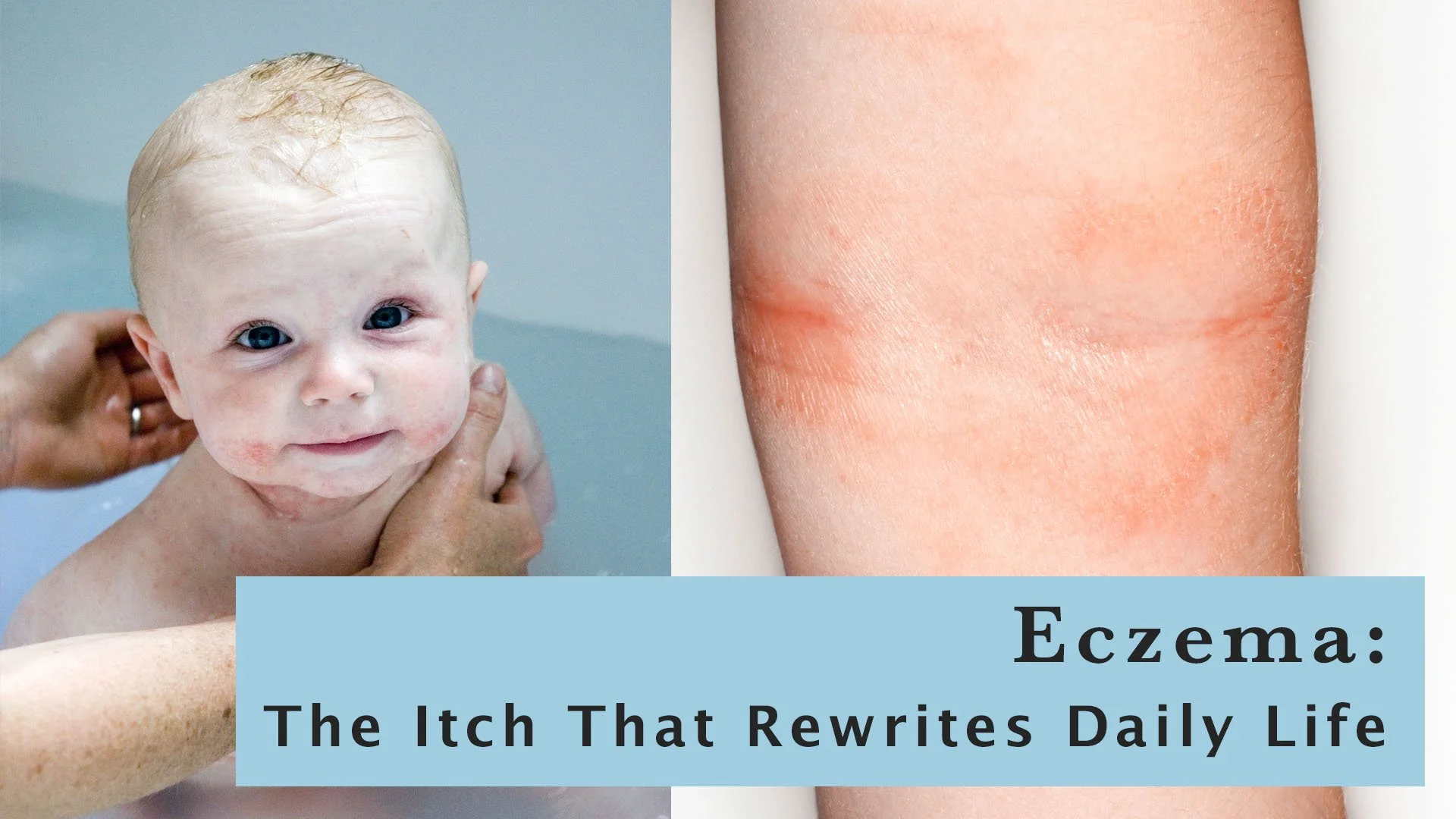
If you've ever watched a baby scratch relentlessly at their own skin, or seen an adult with raw, cracked hands try to explain why they can't simply "stop itching," you already understand something essential about eczema: it is far more disruptive than it looks, and it looks different on everyone. Formally known as atopic dermatitis, eczema affects an estimated 230 million people worldwide — making it one of the most prevalent chronic skin conditions on the planet. And yet, for all its reach, it remains one of the most visually underserved topics in medical publishing. That gap is closing fast, and the demand for accurate, diverse, clinically credible imagery has never been greater.
Eczema — Atopic Dermatitis Stock Images
What Is Eczema? The Short Version
Chronic inflammatory skin condition characterized by dry, itchy, inflamed skin that flares and remits over time
Not contagious, caused by a combination of genetic, immune, and environmental factors that compromise the skin's barrier function
Approximately 50% of cases begin during the first year of life and 85% by age five, but it can develop or persist at any age, including in older adults
Affects all skin tones, ages, and body types, but presents very differently depending on skin tone, age, and body location
Common presentation sites include the inner elbows, backs of knees, hands, face, neck, and scalp, though it can appear anywhere
Part of the "atopic triad": eczema frequently occurs alongside asthma and allergic rhinitis, reflecting its systemic immune roots
Symptoms range from mild dryness and irritation to severe, widespread inflammation that disrupts sleep, work, and quality of life
Eczema in Context: Who Gets It and Why It's Undercovered
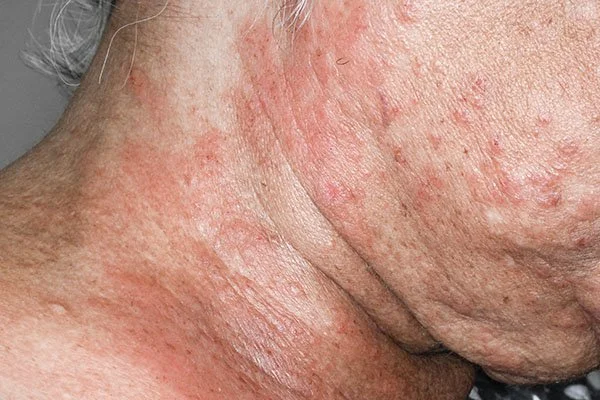
Eczema on the neck of an 89 year old female patient. © Dr. P. Marazzi / Science Source
Prevalence rates in the US are estimated at 8% to 18% in children and up to 10% in adults, making it one of the most common conditions a medical publisher will ever need to illustrate
Disproportionately affects urban populations and higher-income countries, though the reasons remain an active area of research
Despite its prevalence, eczema has been chronically underrepresented in medical imagery, particularly in children and across diverse skin tones
On darker skin, eczema may appear brown, violet, or gray rather than the classic red, and lichenification (skin thickening from chronic scratching) can be more pronounced, distinctions that are clinically meaningful and visually distinct
Significant stigma around visible skin conditions, combined with the particular sensitivity around photographing infants and children, has historically made quality eczema photography scarce
Growing patient advocacy and regulatory pressure for diverse representation in medical education are driving urgent demand for imagery that reflects real patient populations
A Treatment Revolution — Still in Progress
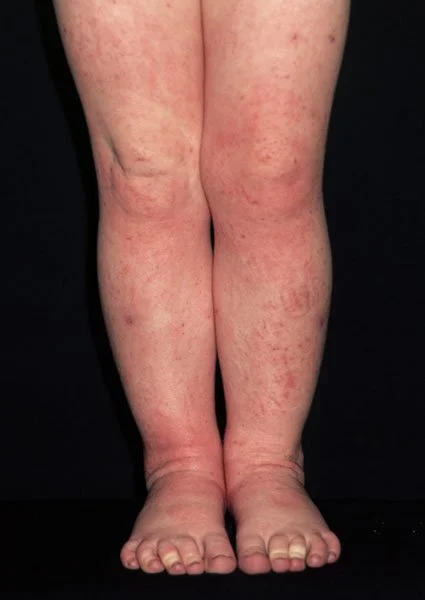
Eczema on a three-year-old girl's legs. © Dr P. Marazzi / Science Source
Eczema was once managed almost exclusively with moisturizers, topical corticosteroids, and broad immunosuppressants that had significant long-term side effects. The past decade has brought a remarkable transformation:
Dupilumab (approved 2017) — the first biologic approved for atopic dermatitis, targeting the IL-4 and IL-13 pathways, it changed the standard of care for moderate to severe disease and opened the door to a new era of targeted therapy
Lebrikizumab (approved 2024) — an IL-13 inhibitor with a monthly maintenance dosing schedule after an initial loading phase, making it the most convenient long-term biologic option currently available
Nemolizumab (approved December 2024) — the first biologic to specifically target IL-31, the key cytokine responsible for the intense itching that is often more debilitating than the visible rash itself
JAK inhibitors — oral and topical options (abrocitinib, upadacitinib, ruxolitinib) providing additional pathways for patients who don't respond to biologics
Ongoing clinical trials continue to identify new immune targets, making atopic dermatitis one of the most active areas in all of dermatology publishing
Each new approval generates a fresh wave of pharmaceutical communications, patient education materials, continuing medical education content, and journal coverage — all of which require current, accurate, licensable imagery.
Why Accurate Eczema Imagery Matters for Publishers
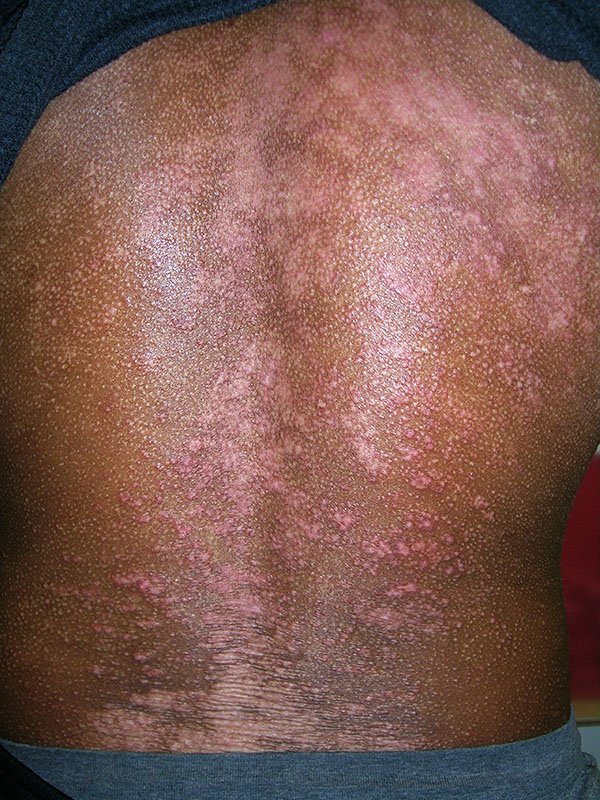
Atopic dermatitis on the back of a black male patient. © Richard Usatine Md / Science Source
Eczema is deceptively difficult to illustrate well. The condition is highly variable and deeply personal, carrying an emotional weight that generic imagery consistently fails to capture.
Age range is critical: eczema in infants looks nothing like eczema in adults, and pediatric imagery requires particular care around model releases and sensitivity
Skin tone diversity is non-negotiable: the clinical presentation differs significantly across skin tones, and educational materials that show only one presentation do a disservice to patients and clinicians alike
Body location matters: inner elbows and knees are the classic teaching images, but hands, face, scalp, and eyelids are all common sites with distinct visual and editorial needs
Severity spectrum: mild, moderate, and severe presentations serve entirely different publishing contexts, from consumer health magazines to clinical dermatology journals to pharmaceutical approval submissions
The itch is invisible: medical illustration plays an essential role in explaining the immune cascade, skin barrier dysfunction, and nerve pathway involvement that drives the itch-scratch cycle; photography alone cannot tell this story
Complications require their own imagery: eczema herpeticum (a serious viral complication), infected eczema, and contact dermatitis overlapping with atopic dermatitis all represent distinct clinical scenarios with real publishing demand
What Science Source Brings to the Table
Science Source offers one of the most extensive eczema and atopic dermatitis collections available for licensing, built specifically to serve the needs of medical publishers, pharmaceutical communicators, and healthcare educators.
Clinical photography spanning infants, children, and adults — including model-released images across a range of ages, skin tones, and body locations
Images documenting mild through severe presentations, including eczema herpeticum and other complications
Diverse skin tone representation, including clinical photography on darker skin tones where the condition's presentation differs meaningfully from textbook imagery
Medical illustrations explaining skin barrier dysfunction, immune pathway involvement, and the mechanisms targeted by modern biologic therapies
A knowledgeable picture research team is available to help you find exactly what your project needs. No obligation
Severe Eczema Clinical Gallery
(Intended for medical, educational, and publishing professionals; images depict significant disease progression)
Whether you're producing a patient education brochure, a pharmaceutical campaign for a new biologic, a pediatric dermatology textbook, or a continuing medical education module, the visual demands of covering eczema are specific, and the stakes for accurate representation are high. Science Source has the depth, the diversity, and the scientific credibility to support that work at every level.
Questions? Our team is here to help. Contact us