
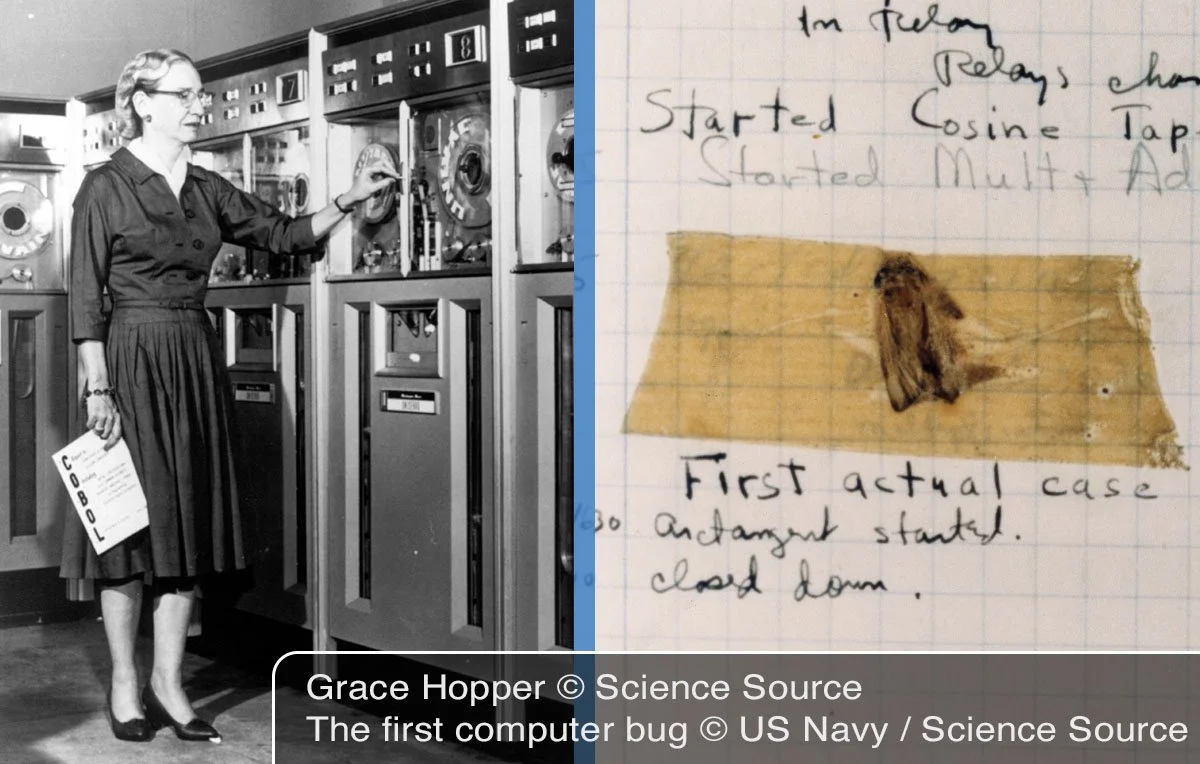
Did you know that the first instance of “debugging” a computer involved an actual insect? In 1947, engineers working on the Mark II computer at Harvard University discovered a moth trapped in a relay, causing a malfunction. Grace Hopper, a pioneering computer scientist, recorded the incident in the logbook—coining the now-famous term “debugging.” Ever since, “debugging” has become a standard part of computer science vocabulary.
Grace Hopper, affectionately known as “Amazing Grace,” achieved numerous milestones in computer science. She was the first to use a compiler to translate English into computer code, making programming more accessible. Hopper invented COBOL, one of the first and most influential programming languages still in use today, and she played a key role in developing the UNIVAC—the first commercially produced computer designed for business and data processing.
Gallery of Grace Hopper Images
Hopper’s academic journey was equally impressive. She earned her Ph.D. in mathematics and mathematical physics from Yale University and taught at Vassar College. During World War II, she sought to join the WAVES, the women’s branch of the U.S. Naval Reserve. Though her mathematical talents were deemed too valuable for typical service, she was granted a special commission and assigned to the Bureau of Ships Computation Project at Harvard as a lieutenant, junior grade.
Grace Hopper’s distinguished career continued for decades. She finally retired at the age of 79 as a Rear Admiral, making her the oldest active-duty officer in the U.S. Navy at the time. Her groundbreaking work was recognized with many honors, including the Presidential Medal of Freedom.
From the first computer “bug” to revolutionizing how we communicate with machines, Grace Hopper’s legacy continues to inspire generations of scientists, engineers, and innovators.
ScienceSource.com is here to provide you with the visual resources you need for your science communication. Whether it’s historical or cutting-edge, we’re here for you.