
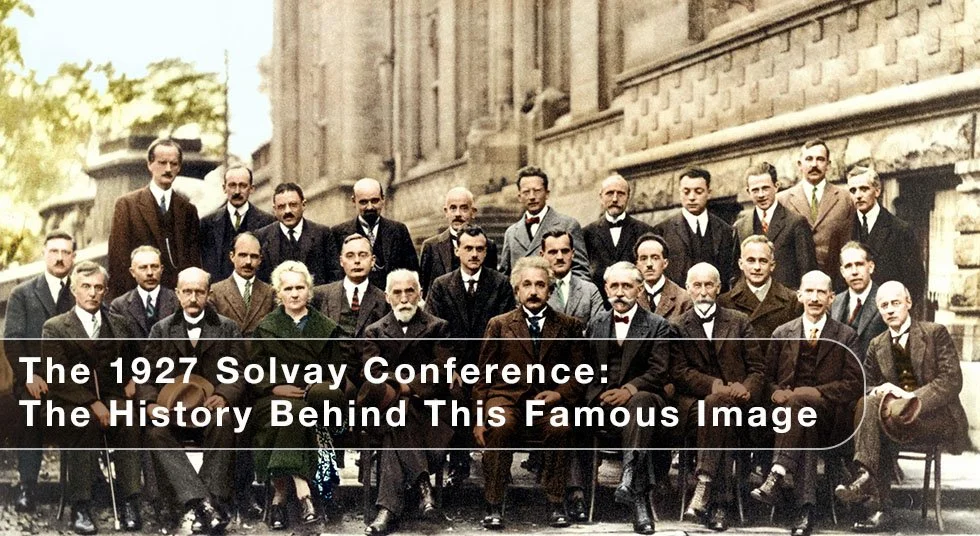
Every field has one image that does more work than any textbook chapter. For quantum physics, it's a single photograph taken in Brussels in October 1927: 29 physicists and chemists arranged in three tidy rows, 17 of whom either held a Nobel Prize already or would collect one shortly after. Einstein sits dead center, arms folded, wearing the expression of a man who has heard an argument he does not intend to lose. Marie Curie sits beside him — the only woman in the room, and, not incidentally, the only person ever to win Nobel Prizes in two different sciences. It is, by wide consensus, the most reproduced "smartest room ever assembled" photograph in existence, to the point that most publishers could probably sketch it from memory.
Gallery of 1927 Solvay Conference of Physics Stock Images
What Was the Solvay Conference? The 1927 Meeting That Changed Physics
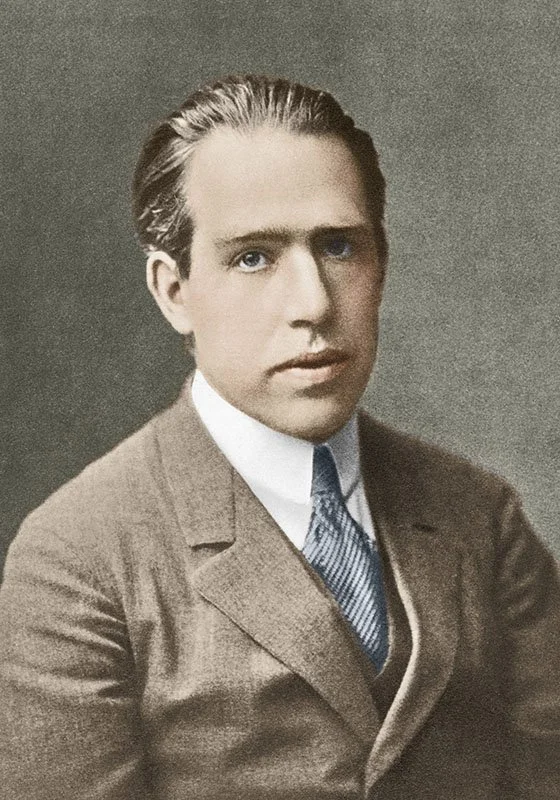
Niels Bohr, Danish Physicist. © Science Source
The Solvay Conferences began in 1911, underwritten by Ernest Solvay, a Belgian industrial chemist whose fortune came from an efficient new method of producing soda ash — and who decided that fortune should also fund a standing invitation for the world's leading physicists to argue in one room. By the fifth conference, the subject was "Electrons and Photons," and the invitation list amounted to a working index of modern physics: Bohr, Heisenberg, Schrödinger, Dirac, de Broglie, Born, Compton, Planck, Curie, Einstein.
The real substance of that week happened off camera. Einstein spent the conference contesting the emerging Copenhagen interpretation of quantum mechanics, unwilling to accept a universe governed by probability rather than certainty — the position behind his famous remark that God does not play dice with the universe. Bohr's reply, that it was not Einstein's place to tell God what to do, became the opening exchange in a debate the two men never fully resolved and that physicists still cite as foundational. The photograph was taken at the close of that week, which is part of why it holds up as an image: it's a portrait of people who had just spent several days disagreeing, rigorously and in person, about the nature of reality.
Why the Solvay Conference Photo Still Matters for Publishers and Editors
A well-written paragraph can explain the uncertainty principle. A photograph of the room where it was argued into existence does something a paragraph cannot: it makes the history feel adjudicated by actual people, not abstracted into a diagram. That's why editors keep reaching for the Solvay photo across physics textbooks, science history retrospectives, museum wall text, and documentary title sequences — it is rigorous enough to withstand a caption written by a physicist and recognizable enough to function as a cultural reference on its own.
The complication is that nearly everyone is reaching for the identical black-and-white scan. When a single frame has appeared in a hundred prior publications, using it again reads as the default choice, not a deliberate one. An alternate treatment — or an alternate frame from the same event — is often the more defensible editorial decision, not merely the more decorative one.
Exclusive Hand-Colorized Solvay Conference Images from Science Source
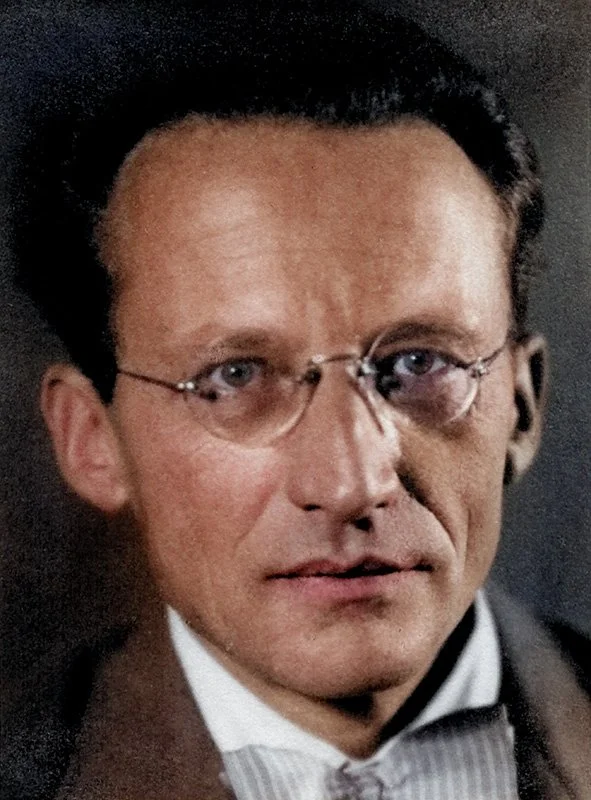
Erwin Schrodinger, Austrian Physicist. © Science Source
Our hand-colorized version of the full Solvay group portrait is a genuine rarity in this market: true archival colorization requires research into period materials, lighting, and tone alongside real restoration skill, and few collections have invested in doing it well. Beyond the group image, we hold individual archival portraits of the conference's most notable attendees — several also available colorized. Together, these give a publisher the material to build a visual narrative around the conference rather than relying on the one image everyone has already seen.
License Solvay Conference Photos and Historical Science Images
We've assembled a gallery of notable Solvay attendees — individual portraits, colorized selections, and related illustrations — for browsing in one place.
Browse the full collection at sciencesource.com, or contact our licensing team directly — we're glad to help track down the exact image a project needs.