
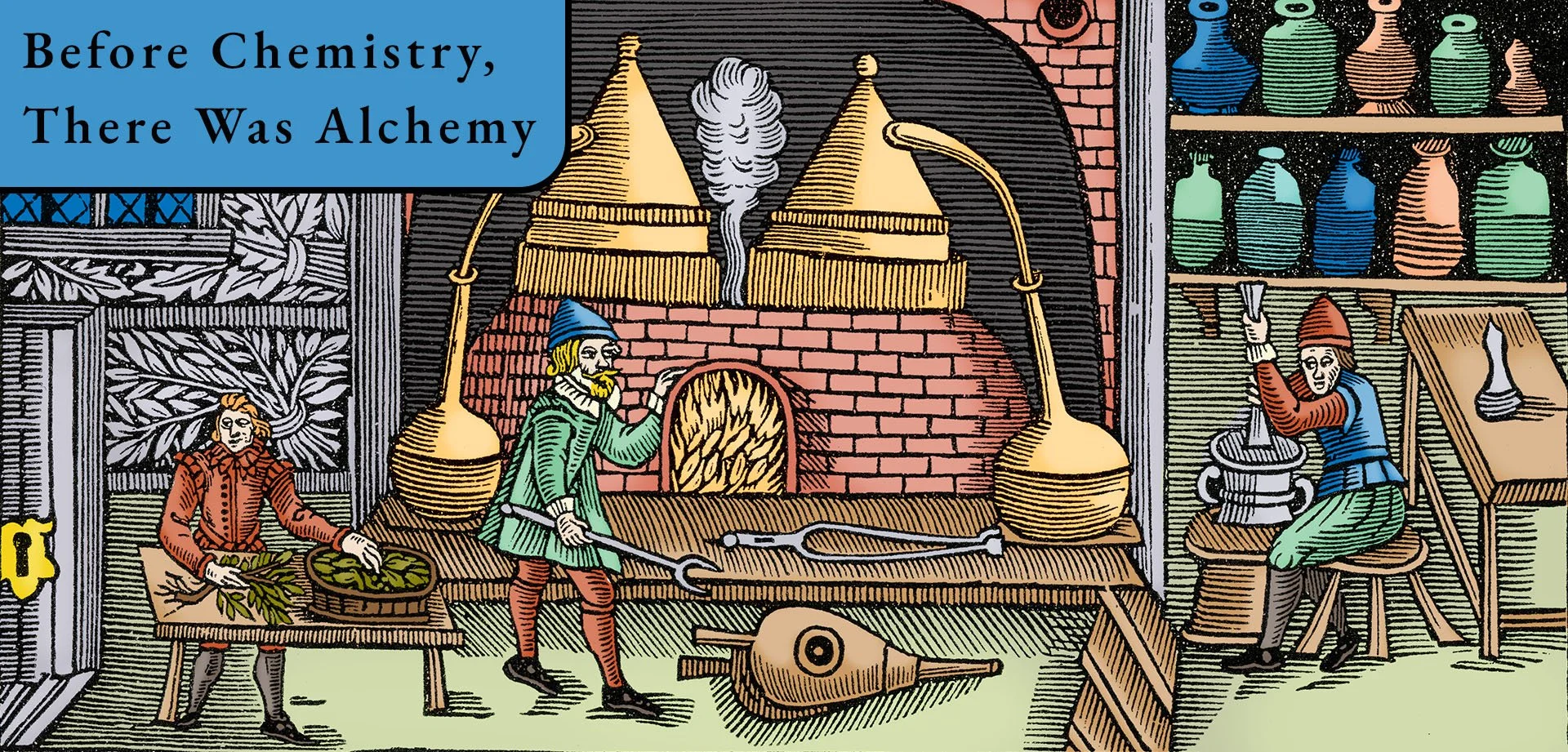
For publishers and educators building content on the history of science, chemistry, and medicine
Some of the most consequential scientific discoveries in history were written in symbols no one alive can fully read. The alchemists who made them worked in secret — not out of academic caution, but out of genuine fear of execution. Political and religious authorities across medieval and early modern Europe viewed alchemy with deep suspicion, associating its fires, vapors, and cryptic inscriptions with witchcraft and heresy. The price of transparency could be death.
So the alchemists encoded their findings. They developed elaborate systems of symbols — for elements, processes, celestial bodies, and transformations — that obscured their work from hostile eyes. Because secrecy was survival, they rarely shared those findings. Discoveries overlapped. Researchers identified the same substances independently, multiple times, without knowing others had been there first. Some findings were lost entirely, sealed in manuscripts that remain only partially decoded to this day.
What survived, however, was extraordinary. The practice we now regard as a failed attempt to turn lead into gold was also the crucible in which the laboratory was invented, elements were isolated, medicines were developed, and the habits of mind that would become the scientific method were slowly, painfully forged. Alchemy did not fail to become chemistry. It became chemistry — and along the way, it laid unexpected foundations for modern medicine as well.
Gallery of Alchemy History Stock Images
At Science Source, our historical science collection includes alchemical laboratory scenes, manuscript illustrations, alchemical symbol charts, and portraits of the figures who shaped this long transition. For publishers building content on the history of science, the origins of chemistry, or the development of scientific methodology, these images offer a depth of historical authenticity that generic illustration cannot provide.
The Origins of Alchemy: Ancient Egypt to Medieval Europe
Alchemy did not begin in a medieval dungeon. Its roots reach back to Greco-Roman Egypt — to Alexandria in the early centuries of the common era, where Greek natural philosophy, Egyptian metalworking traditions, and Babylonian astrology converged into a practice concerned with the transformation of matter. The foundational premise was not purely mercenary: it drew on a genuine philosophical conviction that metals, like living things, developed and matured within the earth, and that human art might accelerate or perfect those natural processes.
Among the earliest figures whose name has survived is Zosimos of Panopolis, a Greek-speaking Egyptian alchemist writing around 300 CE, whose texts represent some of the oldest alchemical manuscripts in existence. Zosimos described laboratory apparatus — distillation equipment, furnaces, vessels for sublimation — that would have been recognizable to chemists centuries later. He also framed alchemy in deeply spiritual terms, as a practice concerned as much with the transformation of the practitioner as with the transformation of metals.
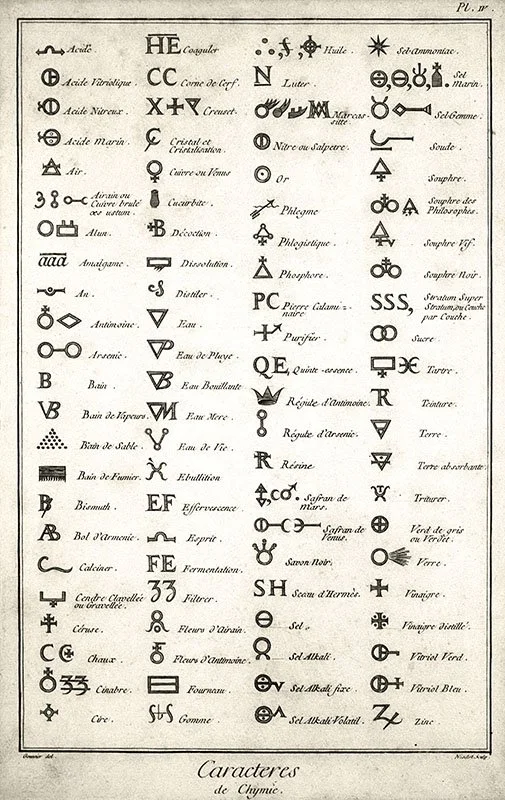
Characters and symbols used by alchemists to represent chemicals, elements, and other objects and processes. © Gregory Tobias/Chemical Heritage Foundation / Science Source
The quest at the center of alchemy — the philosopher's stone — was understood to be both material and transcendent. As a substance, it was theorized to transmute base metals into gold. As a medicine, the same stone, dissolved into a drinkable elixir, was believed capable of curing disease and extending life indefinitely. The dual promise of wealth and immortality drove centuries of investigation, some of it fraudulent, much of it earnest, and a surprising amount of it genuinely productive.
As alchemy moved through the Islamic world and into medieval Europe, it accumulated new practitioners, new hazards, and new secrecy. The Church's suspicion made discretion essential. Rulers alternately patronized alchemists, hoping for gold, and persecuted them when results failed to materialize. Working in this environment, alchemists developed the symbolic language that makes their manuscripts so difficult to interpret today: a system of glyphs, allegories, and coded references that protected their work and, in doing so, partially sealed it from history.
What Alchemists Actually Did: Laboratory Practice and Accidental Discovery
Strip away the mysticism, and the alchemical laboratory was a serious working environment. Alchemists developed and refined techniques that remain fundamental to chemistry: distillation, sublimation, calcination, filtration, crystallization. They built furnaces capable of sustained high temperatures. They worked with acids, salts, sulfur, mercury, and a widening range of metallic compounds. The apparatus Zosimos described in Alexandria—the alembic, the kerotakis, the water bath still known in France as the bain-marie, named for the Jewish alchemist Maria Hebrea, credited with its development,were genuine laboratory innovations.
The discoveries that emerged from this practice were often accidental, frequently dangerous, and occasionally world-changing. Berthold Schwarz, a German friar working in the 14th century, is credited in some accounts with refining the gunpowder formula that would reshape warfare across Europe, a discovery with consequences its maker almost certainly did not anticipate. Albertus Magnus, the 13th-century philosopher and theologian, documented the isolation of arsenic and contributed systematic observations of chemical processes that influenced the practitioners who followed him.
Maria Zieglerin, a 16th-century German alchemist, represents one of the rare documented female practitioners of the period. Working under the patronage of Duke Julius of Brunswick, she claimed to possess the secret of the philosopher's stone and was involved in producing what she described as lion's blood, an alchemical medicine. Her story ended in execution, accused of fraud and sorcery, a fate that illustrates with terrible clarity the environment in which alchemical work was conducted.
The most viscerally memorable discovery of the alchemical era belongs to Hennig Brand, a Hamburg merchant-alchemist who in 1669 became the first person in recorded history to isolate a chemical element through deliberate experimentation. His method was neither elegant nor pleasant: Brand collected and reduced enormous quantities of human urine—estimates suggest as many as 1,500 gallons over the course of his work—believing that urine's golden color might hold a clue to the transmutation of gold. It did not yield gold. After prolonged heating, what emerged from his retort was a waxy white substance that glowed in the dark and burst into flame on contact with air. Brand named it phosphorus, from the Greek for light-bearer. He had isolated the element now known to be essential to DNA, bone structure, and cellular energy transfer — and he had nearly asphyxiated himself with carbon dioxide in the process of finding it.
Key Figures in Alchemy History: From Mysticism to Scientific Method
The transition from alchemy to chemistry did not happen cleanly or quickly. It was driven by a handful of figures who, working within the alchemical tradition, began to insist on observation, repeatability, and documentation over mystical interpretation.
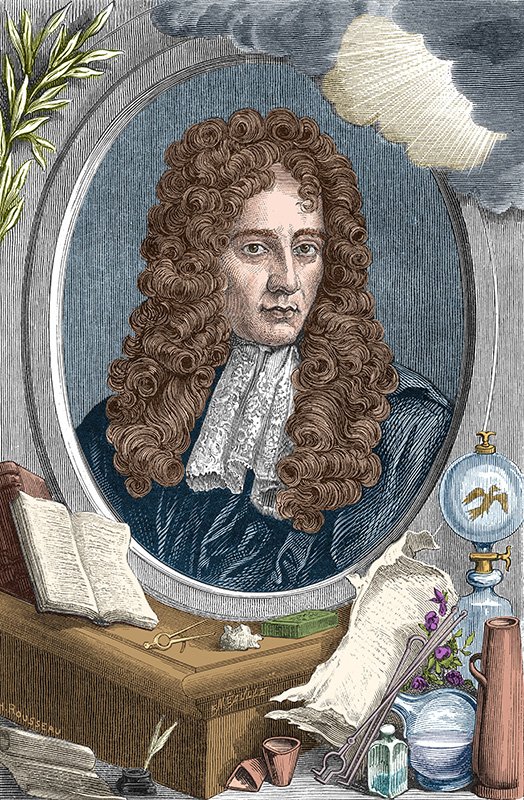
Robert Boyle (1627-1691) was an Irish natural philosopher, chemist, physicist and inventor. Credit Science Source
Robert Boyle, the 17th-century Anglo-Irish natural philosopher, is the figure most often credited with marking the boundary. His 1661 work The Sceptical Chymist directly challenged the Aristotelian framework of four elements — earth, air, fire, water — that had underpinned alchemical theory for nearly two thousand years, and proposed instead that elements should be defined experimentally, as substances that could not be further decomposed. Boyle retained some alchemical interests throughout his life, but his insistence on experimental evidence over received doctrine made him a pivotal figure in the emergence of chemistry as a discipline.
Isaac Newton is less often discussed in this context, but his engagement with alchemy was extensive and serious. Newton devoted a significant portion of his intellectual life to alchemical investigation — his surviving manuscripts on the subject run to nearly a million words — and pursued the philosopher's stone with the same intensity he brought to optics and celestial mechanics. He kept this work almost entirely private, aware of both the professional risk and the legal exposure. Newton's alchemy did not produce the breakthroughs his physics did, but it reflects something important: that the boundary between alchemy and natural philosophy in the 17th century was far more porous than later history suggested.
Antoine Lavoisier, working in France in the late 18th century, completed the transformation Boyle had begun. By isolating oxygen, demonstrating the conservation of mass in chemical reactions, and systematizing chemical nomenclature, Lavoisier effectively closed the alchemical chapter and opened the modern one. He was guillotined during the French Revolution in 1794 — a reminder that even as the era of alchemy's most dangerous associations was ending, the hazards of working at the intersection of knowledge and power had not entirely disappeared.
From Alchemical Symbols to the Scientific Method: The Legacy of Alchemy in Modern Chemistry and Medicine
The philosopher's stone was never found. No alchemist transmuted lead into gold. The elixir of immortality remains, as it always was, a metaphor. And yet the alchemical tradition's legacy in modern science is both real and surprisingly specific.
The laboratory itself — as a dedicated space for controlled experimentation with specialized apparatus — is an alchemical inheritance. Distillation, the technique that gave Brand his phosphorus and still underpins many pharmaceutical purification processes today, was refined in alchemical workshops over centuries. The systematic investigation of acids, alkalis, salts, and metallic compounds that defines inorganic chemistry has direct roots in alchemical practice. Several elements — phosphorus, bismuth, zinc, antimony — were first isolated or carefully described by alchemists working centuries before the formal establishment of chemistry as a discipline.
The contribution to medicine is equally significant, though arrived at differently. Paracelsus, the 16th-century Swiss physician-alchemist, broke decisively with the Galenic medical tradition by insisting that diseases had specific chemical causes and could be treated with specific chemical remedies. His introduction of mineral compounds into medical practice was the beginning of pharmaceutical chemistry. The idea that a substance could be isolated, characterized, and administered in a controlled dose to produce a predictable therapeutic effect is an alchemical idea, refined into the foundational logic of modern pharmacology.
What alchemy ultimately contributed to science was not gold, but method — imperfectly, haltingly, across centuries of secrecy, fear, and misdirection. The habit of observing matter carefully, recording what happened, and attempting to reproduce results did not spring fully formed from the Enlightenment. It was practiced, fitfully and under dangerous conditions, in the smoke-filled workshops of people who believed, not unreasonably, that the universe was knowable and that knowing it mattered.
Alchemy and History of Science Stock Images for Publishers and Educators
For publishers building content on the history of chemistry, the origins of the scientific method, or the development of pharmaceutical science, the visual record of alchemy is remarkably rich — and remarkably underused. The iconography of the alchemical laboratory, the manuscript pages dense with symbolic notation, the portraits of figures poised between mysticism and empiricism: these images carry historical weight that generic science illustration cannot replicate.
Science Source's historical science collection includes imagery across the full arc of this story:
Alchemical laboratory scenes — period engravings and hand-colored etchings showing furnaces, retorts, alembics, and the working environment of alchemical practice
Alchemical symbol charts and manuscript illustrations — the encoded visual language of alchemy, essential for the history of science and philosophy of science publishing
Portraits and etchings of key figures — Zosimos, Boyle, Newton, Lavoisier, and others at the intersection of alchemy and early chemistry
Historical chemistry apparatus — early laboratory equipment documenting the material transition from alchemical workshop to chemical laboratory
Contemporary chemistry imagery — connecting the historical narrative to modern laboratory practice and pharmaceutical science
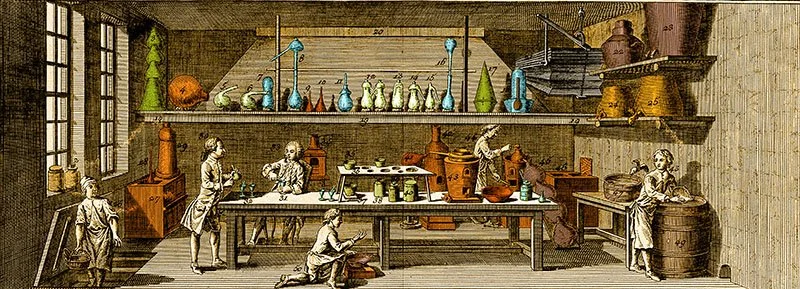
An 18th-century chemical laboratory in Paris, showing instruments, furnaces, chemical vessels, and chemists. Credit Science Source
The search for the philosopher's stone produced neither gold nor immortality. But it produced phosphorus, laboratory technique, pharmaceutical chemistry, and the beginnings of the scientific method — a return on investment that any publisher covering the history of science would recognize as extraordinary. The imagery that documents that journey is available, accurate, and waiting to be licensed.
Browse Science Source's history of science and alchemy collection at sciencesource.com