
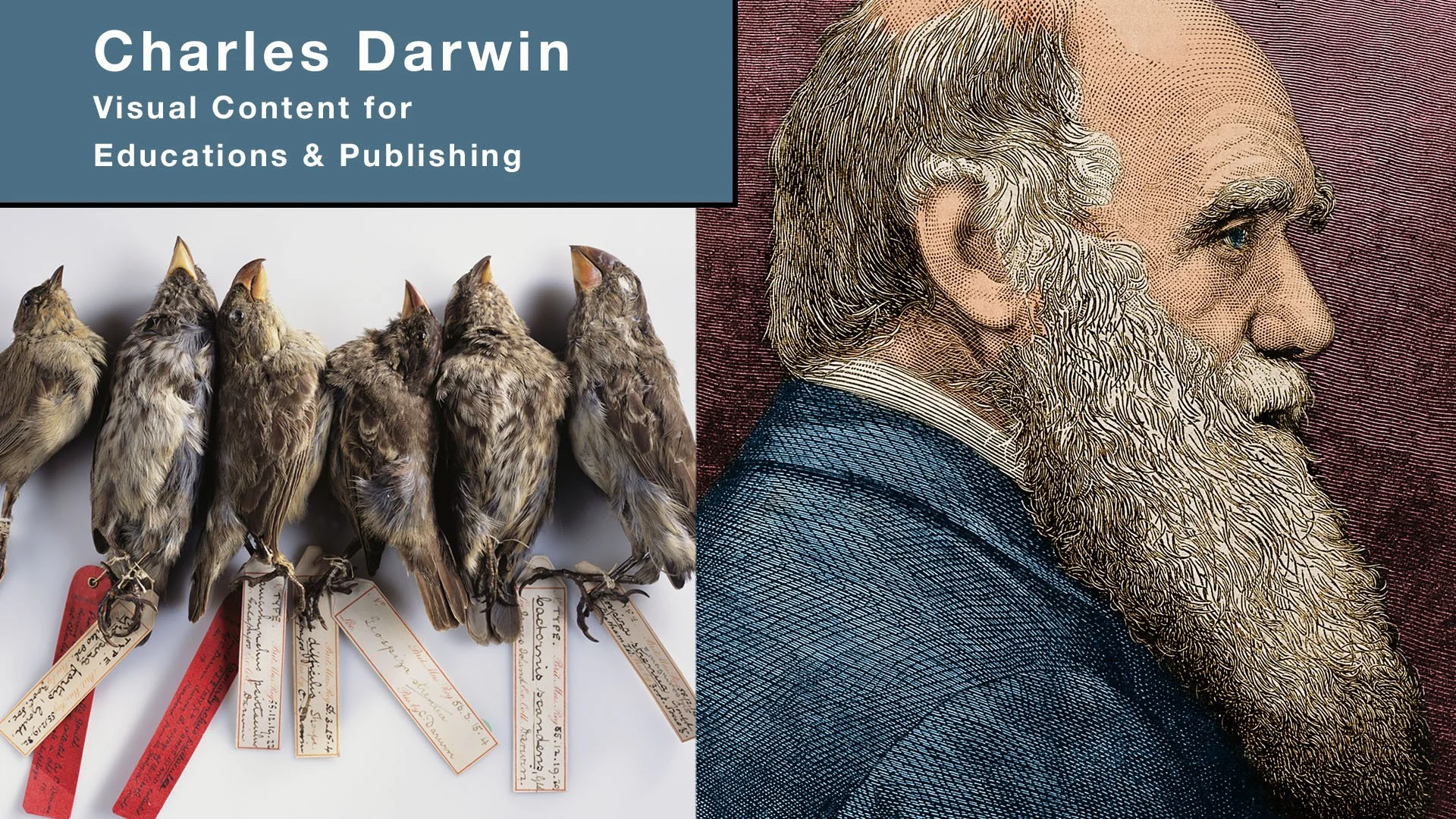
Charles Darwin: Life, the Voyage of the Beagle, and Natural Selection
In 1831, Charles Darwin almost missed the voyage that made him. Captain Robert FitzRoy, a firm believer in reading character from facial features, doubted that a man with Darwin’s nose had the energy and determination for a long survey voyage. Darwin sailed anyway, and returned five years later with thousands of specimens and a question that would reshape biology. Science Source holds a deep collection of Charles Darwin images, from exclusive hand colored portraits to the ship, the voyage, and the world he studied. Here is the story behind them, and what publishers should know when choosing them.
Gallery of Charles Darwin Visual Content
Charles Darwin Biography: Birth, Education, and Early Life
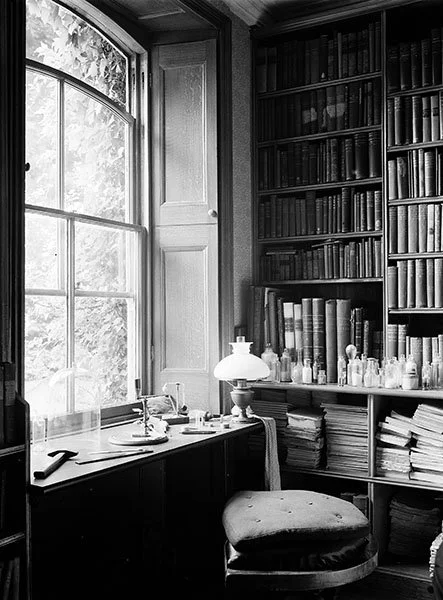
Darwin's Study and Microscope, Down House. Credit Wellcome Images / Science Source
Charles Robert Darwin was born on February 12, 1809, in Shrewsbury, England, into a comfortable family connected to both the Darwin and Wedgwood names. He began medical studies at Edinburgh in 1825 but left them behind, and in 1828 he went to Cambridge to prepare for the clergy. Instead, he pursued natural history: beetle collecting, field walks, and a close mentorship with the botanist John Stevens Henslow.
Cambridge also gave Darwin the Gluttons Club, whose members tried to eat animals not usually found on a menu. The club ended when a brown tawny owl was so stringy, tough, and unpalatable that it proved inedible. Darwin took his degree in 1831, and Henslow recommended him as a naturalist for HMS Beagle.
Darwin married Emma Wedgwood in 1839 and settled at Down House in Kent in 1842. He died there on April 19, 1882, and was buried in Westminster Abbey.
The Voyage of the HMS Beagle and the Road to Natural Selection
The Beagle left Plymouth in December 1831 on a survey voyage that lasted until October 1836. Darwin spent much of it ashore, riding across South America and collecting along the way. He shipped his finds home in batches:
Fossil mammals from South America, including giant extinct species
Birds, plants, and insects from coastal and inland habitats
Geological samples and field notes from the Andes
Galápagos animals, among them tortoises, mockingbirds, and finches
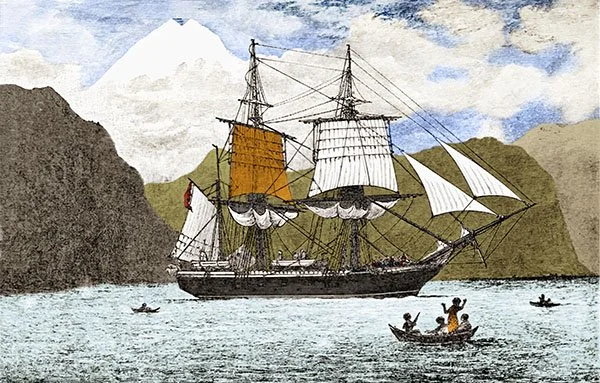
HMS Beagle off the coast of South America. Credit Omikron / Science Source
The popular version of the story has Darwin spotting differences in finch beaks on the Galápagos and instantly grasping evolution. The real story is more complicated. Many of his finch specimens were poorly labeled by island, and he mistook some for wrens, blackbirds, and grosbeaks. Ornithologist John Gould later recognized them as a closely related group of finches with distinct characteristics. Gould's findings helped shape Darwin's thinking, which developed further through subsequent conversations, observations and notebooks.
Darwin developed his ideas for more than two decades. In 1858, he received a manuscript from Alfred Russel Wallace that reached a similar conclusion independently, and the two men’s papers were presented together at the Linnean Society that year.
On the Origin of Species and The Descent of Man
On the Origin of Species appeared in 1859. It argued for descent with modification through natural selection, set against the then prevailing view that species were fixed and separately created. The book says very little about humans.
The Descent of Man followed in 1871 and applied the argument to our own species, along with sexual selection. Darwin proposed that humans and apes share common ancestors, which is different from saying we descended from living apes. Reaction in Victorian Britain was sharp, and the book stirred controversy among readers, clergy, and scientists alike. Public acceptance of evolution still varies widely between countries and surveys, and the conversation around it continues. The science itself rests on more than 160 years of evidence from many fields.
Charles Darwin’s Contributions to Geology
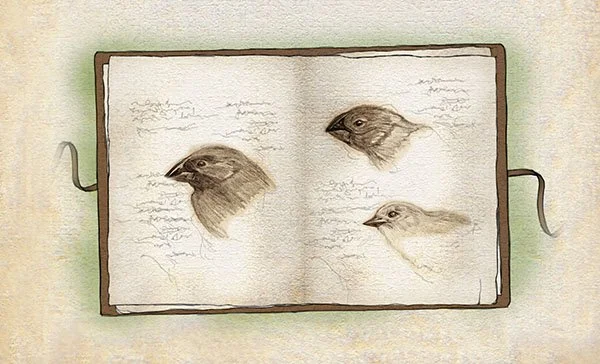
On the Origin of Species by Means of Natural Selection. Credit Q A International / Science Source
Darwin considered himself a geologist first on the voyage. He carried Charles Lyell’s Principles of Geology, which argued that slow, ongoing processes shape the Earth. In Chile in February 1835, he experienced a major earthquake and afterward saw mussel beds lifted above the high tide line. Marine fossils high in the Andes pointed the same way: land rises over very long spans of time, and erosion wears it down.
His coral reef theory, published in 1842, proposed that atolls form as volcanic islands slowly subside while coral keeps growing upward. Later reef drilling supported the basic idea.
His final book, published in 1881, was on earthworms and soil formation. It sold well, suggesting readers of his day were happy to follow him anywhere.
Why Accurate Images of Charles Darwin Matter
Darwin appears frequently in textbooks, documentaries, and online educational materials, yet the same familiar portraits are often reused. Choosing supporting images requires some care. Ships can be mislabeled, specimens attributed to the wrong island, and historical illustrations incorrectly credited.
Well-researched imagery helps put Darwin's work in context. Portraits, illustrations of the Beagle, South American landscapes, and Galápagos wildlife help show the people, places, and observations behind his ideas.
Charles Darwin Stock Images and Licensing
Finding the right images for a Darwin-related project means looking beyond portraits. Science Source offers a range of historical, scientific, and natural history imagery, supported by carefully researched captions and metadata. With more than 60 years of experience in science and educational imagery, our team can help locate and license visuals for your project.
The collection includes:
Exclusive hand-colored portraits of Charles Darwin
HMS Beagle and voyage illustrations
Galápagos wildlife and landscapes
Historical illustrations and publications
Geology, fossils, and paleontology subjects
Browse Science Source’s Charles Darwin collection at sciencesource.com